

Calculating the amount of HDPE sun shading net needed for a specific area is a crucial step for many agricultural, horticultural, and even some industrial applications. As a supplier of high - quality HDPE sun shading nets, I've encountered numerous customers who are unsure about how to accurately determine the quantity they require. In this blog, I'll guide you through the process, ensuring that you can make an informed purchase.
Understanding the Basics of HDPE Sun Shading Nets
Before we dive into the calculations, it's important to understand what HDPE sun shading nets are. HDPE, or High - Density Polyethylene, is a strong and durable plastic material. Hdpe Sun Shading Net is made from this material and is designed to block a certain percentage of sunlight, providing shade for plants, livestock, or other items that need protection from excessive sun exposure.
These nets come in various shading percentages, typically ranging from 30% to 90%. The higher the percentage, the more sunlight the net will block. For example, a 70% shading net will block 70% of the sunlight, allowing only 30% to pass through. The choice of shading percentage depends on the specific needs of your application.
Measuring the Area
The first step in calculating the amount of HDPE sun shading net needed is to accurately measure the area that you want to cover. The area can be of different shapes, such as rectangles, squares, circles, or irregular shapes.
Rectangular or Square Areas
For rectangular or square areas, the calculation is straightforward. You need to measure the length (L) and the width (W) of the area in meters. The area (A) is then calculated using the formula:
[A = L\times W]
For example, if you have a rectangular garden with a length of 10 meters and a width of 5 meters, the area is (A = 10\times5=50) square meters.
Circular Areas
If the area is circular, you need to measure the radius (r) of the circle. The area (A) of a circle is calculated using the formula:
[A=\pi r^{2}]
where (\pi) is approximately 3.14. For instance, if the radius of a circular greenhouse is 3 meters, the area is (A = 3.14\times3^{2}=3.14\times9 = 28.26) square meters.
Irregular Areas
For irregular areas, you can divide the area into smaller, regular shapes (such as rectangles, squares, and triangles), calculate the area of each small shape, and then sum them up. Another method is to use a measuring wheel to measure the perimeter of the area and then estimate the area based on the shape. Some advanced tools, like GPS - based area measurement apps, can also provide a relatively accurate measurement of irregular areas.
Considering Overlap and Waste
When installing HDPE sun shading nets, it's necessary to consider overlap and waste. Overlap is required to ensure that there are no gaps in the shading coverage. A common overlap distance is about 10 - 20 centimeters.
To account for overlap, you need to add an extra width and length to the measured area. For example, if you are covering a rectangular area and you plan to have a 15 - centimeter (0.15 - meter) overlap on each side, you need to add 0.3 meters to both the length and the width when calculating the net area.
Waste also occurs during the cutting and installation process. It's recommended to add an additional 5% - 10% of the calculated area to account for waste. So, if the measured area is 100 square meters, after considering a 10% waste, you should order (100\times(1 + 0.1)=110) square meters of HDPE sun shading net.
Selecting the Right Net Size
HDPE sun shading nets are usually available in standard widths, such as 2 meters, 3 meters, 4 meters, and 6 meters. When calculating the amount of net needed, you need to consider the standard widths and how they can be arranged to cover the area.
For example, if you have a rectangular area that is 5 meters wide and 10 meters long, and the net is available in 2 - meter widths. You will need to use at least 3 pieces of 2 - meter - wide net side by side to cover the 5 - meter width. The length of the net required is still 10 meters. So, the total area of the net needed is (3\times2\times10 = 60) square meters.
Different Applications and Their Requirements
Agricultural Use
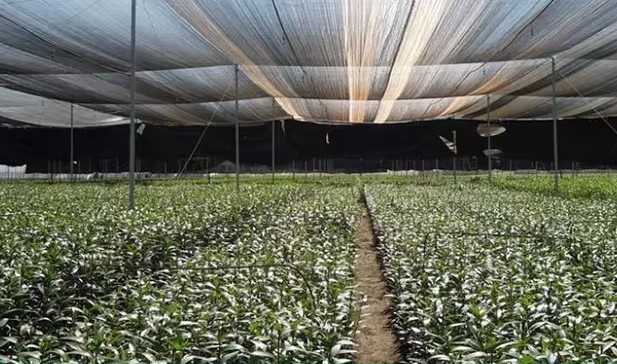
In agriculture, Agricultural HDPE Shade Net is widely used to protect crops from excessive sunlight, heat, and pests. Different crops have different shading requirements. For example, lettuce and spinach prefer a higher shading percentage (around 70% - 90%) as they are sensitive to strong sunlight. On the other hand, tomatoes and peppers can tolerate a lower shading percentage (around 30% - 50%).
When calculating the amount of net for agricultural use, you also need to consider the layout of the fields and the support structures. The net should be properly tensioned and secured to the support structures to ensure its effectiveness.
Greenhouse Use
Greenhouses often use Black Shade Cloth Agriculture Greenhouse to control the temperature and light inside. The shape of greenhouses can be more complex, such as arched or multi - span. When calculating the amount of net for a greenhouse, you need to accurately measure the surface area of the greenhouse, including the sides and the roof.
For arched greenhouses, you can approximate the surface area by considering the greenhouse as a half - cylinder. The surface area of a half - cylinder is (A=\pi rL), where (r) is the radius of the arch and (L) is the length of the greenhouse.
Conclusion
Calculating the amount of HDPE sun shading net needed for a specific area involves accurate area measurement, consideration of overlap and waste, and selection of the right net size. By following the steps outlined in this blog, you can ensure that you order the correct amount of net for your needs.
As a professional HDPE sun shading net supplier, we offer a wide range of high - quality nets with different shading percentages and widths. If you have any questions about calculating the amount of net needed or need help in selecting the right product for your application, please feel free to contact us for further discussion and procurement negotiation. We are committed to providing you with the best solutions and services.

References
- Agricultural Engineering Handbook: This handbook provides detailed information on agricultural structures and shading materials, including HDPE sun shading nets.
- Journal of Horticultural Science: Articles in this journal often discuss the impact of shading on plant growth and the selection of appropriate shading materials.


